
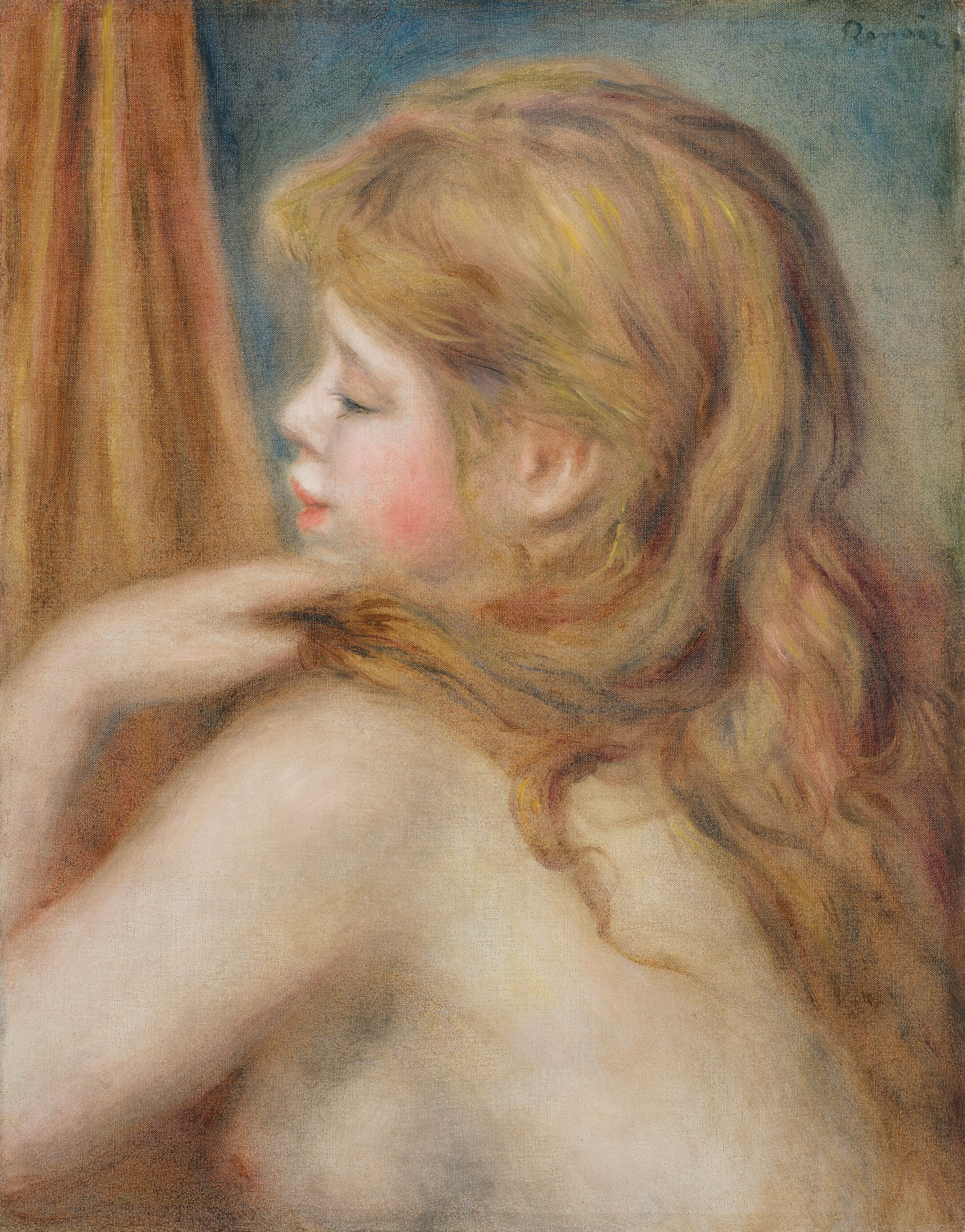
Buste de jeune fille nue
- Year
- Painted circa 1890-1891
- Medium
- Oil
- Size
- 41×31.8cm, 16.14×12.52 inch
Exhibitions
Paris, Galeries Durand-Ruel, Portraits par Renoir, June 1912, no. 22, n.p. (titled 'Portrait de Jeune Fille' and dated '1890'). New York, Durand-Ruel Galleries, Exhibition of Paintings by Renoir, January 1924, no. 10, n.p. (titled 'Jeune fille' and dated '1890'). New York, Durand-Ruel Galleries, Exhibition of Small Paintings by Renoir, December 1927, no. 13, n.p. (titled 'Jeune fille' and dated '1890'). New York, The Metropolitan Museum of Art, Renoir, A Special Exhibition of His Paintings, May - September 1937, no. 50, n.p. (illustrated; titled 'Young Girl'). New York, Duveen Galleries, Centennial Loan Exhibition, Renoir, November - December 1941, no. 69, p. 159 (illustrated p. 91; titled 'Jeune fille' and dated 'about 1894'). Tokyo, Galeries Seibu, Rétrospective Pierre-August Renoir, October 1971 - November 1971, no. 29, n.p. (illustrated; titled 'Tête de jeune fille' and dated '1890'); this exhibition later travelled to Fukuoka, Centre Culturel, December 1971; and Kobe, Musée d'Art Moderne de la Préfecture de Hyogo, January - February 1972. Chicago, The Art Institute, Paintings by Renoir, February - April 1973, no. 58, n.p. (illustrated; titled 'Head of a Young Girl' and dated '1890').
Publications
J. Meier-Graefe, Renoir, Leipzig, 1929, no. 208, pp. 209 & 442 (illustrated p. 209; titled 'Junges Mädchen'). L'Art Vivant, Paris, July 1933 (illustrated on the cover). M. Drucker, Renoir, Paris, 1944, pp. 84 & 217 (illustrated p. 84; titled 'Jeune fille à la mèche'). Art Institute of Chicago, ed., Paintings in the Art Institute of Chicago, Chicago, 1961, p. 398 (titled 'Head of a Young Girl' and dated 'circa 1890-1894'). F. Daulte, Auguste Renoir, Catalogue raisonné de l'oeuvre peint, Figures, 1860-1890, vol. I, Lausanne, 1971, no. 613, n.p. (illustrated; titled 'Tête de Jeune fille'). G.-P. & M. Dauberville, Renoir: Catalogue raisonné des tableaux, pastels, dessins et aquarelles, 1882-1894, vol. II, Paris, 2009, no. 1386, p. 441 (illustrated; titled 'Tête de Jeune fille' and dated 'circa 1890-1894').
This work will be included in the forthcoming Pierre-Auguste Renoir Digital Catalogue Raisonné, currently being prepared under the sponsorship of the Wildenstein Plattner Institute, Inc.
This work will be included in the forthcoming Pierre-Auguste Renoir Digital Catalogue Raisonné, currently being prepared under the sponsorship of the Wildenstein Plattner Institute, Inc.
- Work code
- 13879
Pierre-Auguste Renoir
Pierre-Auguste Renoir, often considered alongside Monet to be one of the leaders of the Impressionist movement, was born in 1841 in Limoges, a town in south-central France. The son of a poor tailor, he moved to Paris with his family when he was three years old. At 13 years old, he became a porcelain painter, but lost his job due to the Industrial Revolution, and so began painting.
In 1861, at the age of 20, he entered the studio of Charles Grelle in Paris, where he met Monet, Sisley, and other future members of the Impressionist movement. In 1869, while working outdoors with Monet, he is said to have developed the technique of brushstroke division, in which colors are not mixed on a palette but placed directly as dots on a canvas.
Following his lack of success at the Salon, Renoir, Monet, and other fellow painters organized an exhibition in 1874 that would later be known as the “First Impressionist Exhibition". Renoir participated in the third Impressionist exhibition and the seventh in 1882, but he gradually withdrew from the Impressionist movement. Around this time, he gained a patron, the Charpentier's, and established himself as a successful portrait painter.
In the 1880s, he traveled to Italy and Algeria, where he was greatly influenced by the classical art which he encountered. He began to emphasize in his paintings, strict outlines and quantitative expression. In his the period after 1890, he produced many warm-toned paintings of female nudes, characterized by soft colors and light.
Suffering from rheumatism in his later years, Renoir moved to Cagnes-sur-Mer in southern France, where he continued to work energetically while strapping a paintbrush to his immobile right hand. He passed away in 1919.
In 1861, at the age of 20, he entered the studio of Charles Grelle in Paris, where he met Monet, Sisley, and other future members of the Impressionist movement. In 1869, while working outdoors with Monet, he is said to have developed the technique of brushstroke division, in which colors are not mixed on a palette but placed directly as dots on a canvas.
Following his lack of success at the Salon, Renoir, Monet, and other fellow painters organized an exhibition in 1874 that would later be known as the “First Impressionist Exhibition". Renoir participated in the third Impressionist exhibition and the seventh in 1882, but he gradually withdrew from the Impressionist movement. Around this time, he gained a patron, the Charpentier's, and established himself as a successful portrait painter.
In the 1880s, he traveled to Italy and Algeria, where he was greatly influenced by the classical art which he encountered. He began to emphasize in his paintings, strict outlines and quantitative expression. In his the period after 1890, he produced many warm-toned paintings of female nudes, characterized by soft colors and light.
Suffering from rheumatism in his later years, Renoir moved to Cagnes-sur-Mer in southern France, where he continued to work energetically while strapping a paintbrush to his immobile right hand. He passed away in 1919.
